Why Radiology Will Be the First Medical Specialty Fully Replaced by AI
For decades, the radiologist has been medicine's pattern-matcher in chief: a person trained to stare at grayscale slices of the human body and spot the shadow that shouldn't be there. It's a job built entirely on image interpretation — and image interpretation is exactly the kind of task machine learning has gotten ruthlessly good at. The only question left isn't whether AI replaces radiology. It's how fast, and what replaces the radiologist's other job: deciding who gets scanned at all.
The Bottleneck Was Never the Reading — It Was the Access
Radiology has always had two separate bottlenecks. The first is interpretation: someone has to look at the image and say what it means. The second, less talked about, is access: someone has to get the image in the first place. MRIs are expensive, slow, and scarce. CT scans carry radiation. Ultrasounds are operator-dependent. For most of the population, "getting imaged" only happens after something has already gone wrong.
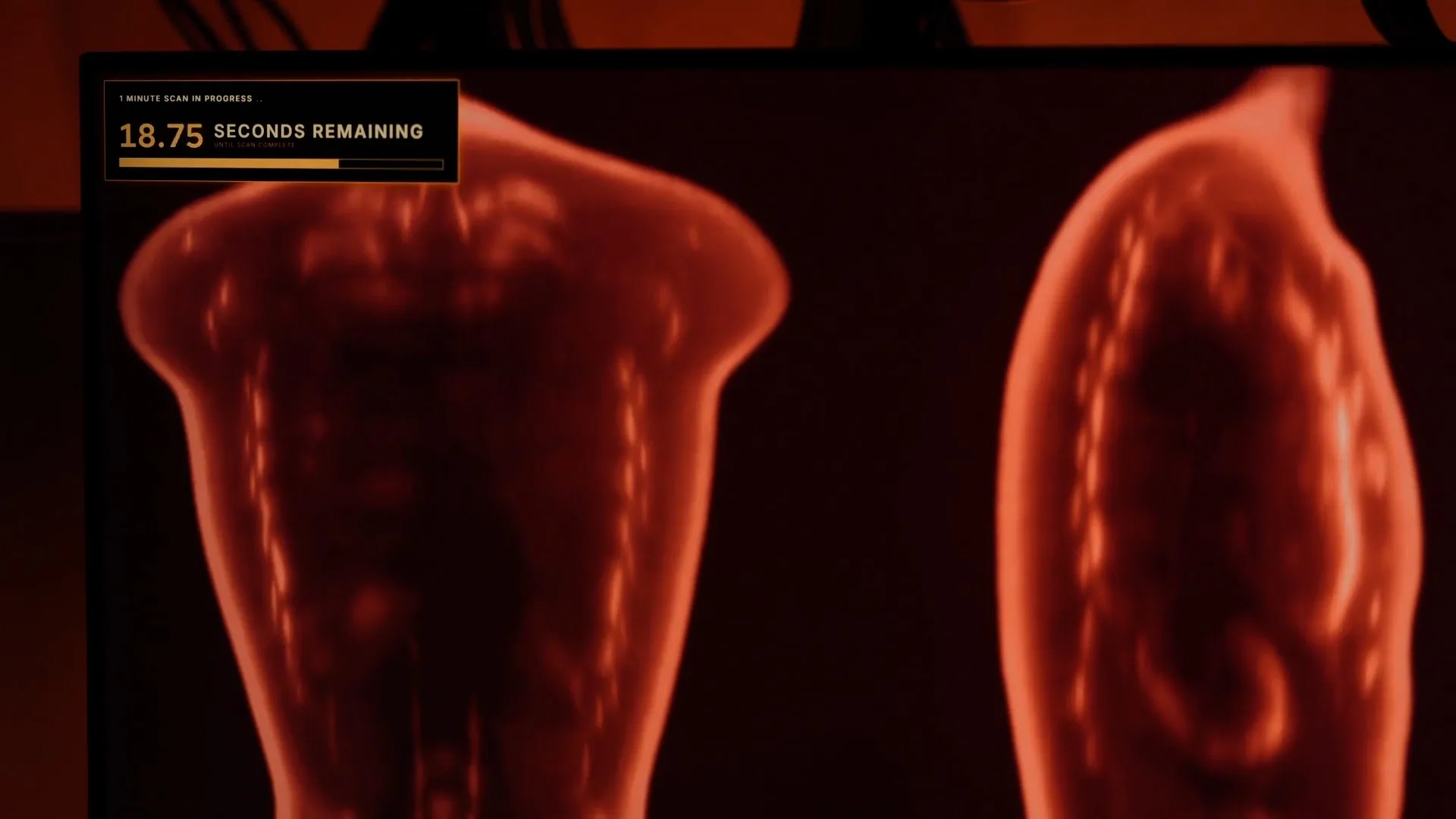
This is the bottleneck Midjourney Medical is targeting with its newly announced full-body scanner. The company describes wanting to build something as powerful as MRI and as casual as a trip to the spa, using a ring of underwater ultrasonic sensors that send sound waves through the body from every angle to reconstruct a 3D image. The stated goal is a scan that takes no more than 60 seconds — you step into the water, and you're done.
That single design constraint — 60 seconds, no radiologist required to operate it, no referral required to access it — is the real disruption. It's not a faster way to read films. It's a world where nobody has to "order" an image anymore, because the image is just something you get, the way you get a blood pressure reading.
The Data Problem Solves Itself, and So Does the Interpretation Problem
Midjourney frames the entire project around a simple idea: people want as much data as possible about their health, as quickly and cheaply as possible — essentially optimizing for megabytes of body data per second per dollar. A scanner that produces that much imaging data, that frequently, was never going to be interpreted by a finite number of trained humans reading one study at a time. The math doesn't work. Each scan reportedly produces so much raw information that, in their words, you'd need 500 hours of video for every second of scan data. No radiology department on earth reads at that pace. Only a model does.
And this is where the segmentation work already shown in early scan galleries matters: the system isn't just producing pretty cross-sections of a torso or thigh, it's pairing every reconstructed slice with an AI-generated segmentation — the model already labeling what it's looking at, organ by organ, tissue by tissue, before a human ever sees it. That's the diagnostic step. That's the part of the job description that used to require a residency.
From Episodic Diagnosis to Continuous Monitoring
The deeper shift isn't technical, it's conceptual. Traditional radiology is episodic: something hurts, a doctor orders a scan, a radiologist reads it, a diagnosis follows. Midjourney's pitch reframes imaging as continuous and ambient — something layered into a spa visit, where the scans are a side effect of soaking in a hot tub, and you walk out having quietly built a running library of data about your own body over years.
Once imaging becomes that frequent and that cheap, human-in-the-loop interpretation isn't just unnecessary — it becomes the constraint holding everything else back. You can't have a radiologist review a billion scans a month. The company's own roadmap puts the number at exactly that scale: a goal of over 50,000 scanners worldwide by 2031, with a billion scans a month in capacity. At that volume, "AI-assisted" interpretation isn't an upgrade to the old workflow. It is the workflow. A human radiologist isn't in the room; they're, at best, an auditor of a system that's already made the call.
The Stakes Midjourney Is Betting On
What makes this more than a tech demo is the scale of the outcome being promised. The company argues that with enough early, continuous imaging, society could avoid 30% of all deaths and 50% of all healthcare costs. Whether or not that exact figure holds up, it captures the logic correctly: most of what radiology catches today, it catches late, because imaging is rationed by cost and access. Remove the rationing, and the entire specialty stops looking like a profession of scarce expert judgment and starts looking like a pattern-recognition utility running in the background of normal life — closer to a smoke detector than a doctor's appointment.
What's Left for Humans
None of this means physicians disappear. It means the radiologist's specific function — sitting in a dark room, reading films one at a time, calling out abnormalities — stops being something the system needs a human to do at scale. What's left is judgment at the edges: ambiguous findings, complex case management, the conversation with a frightened patient about what a finding actually means for their life. That's a smaller, different job than "radiologist" as it's understood today, and a much smaller number of people will be needed to do it.
The Other Side of the Argument
It's worth being honest about how contested this claim is. Midjourney Medical is, as of this writing, an unreleased product with no FDA-cleared diagnostic capability — the company itself says it's starting with body composition mapping and will submit results to the FDA over time for expanded clearance, with its first physical spa not opening until 2027. Critics of "AI replaces radiology" predictions point out that radiologists already incorporate AI tools today and the specialty's job postings and reading volumes have kept growing, not shrinking; that regulatory approval for autonomous diagnostic AI is a far higher bar than approval for a consumer wellness scanner; that liability law in most countries currently requires a licensed physician to sign off on a diagnosis; and that the hardest part of radiology was never raw pattern-matching but handling rare, ambiguous, or atypical presentations where training data is thin. Whether ambient, ultra-cheap imaging at the scale Midjourney describes actually arrives — and whether regulators and hospitals let AI read it unsupervised even if it does — remains very much an open question.